
Common Myths About Dizziness and Balance Disorders
What Patients Should Know
Dizziness and balance problems can be scary and frustrating. Unfortunately, there is a lot of misinformation that can leave people confused or discouraged.
At Novasound Hearing & Balance Center, we want to clear up the confusion by debunking five common myths about dizziness and vestibular balance disorders.
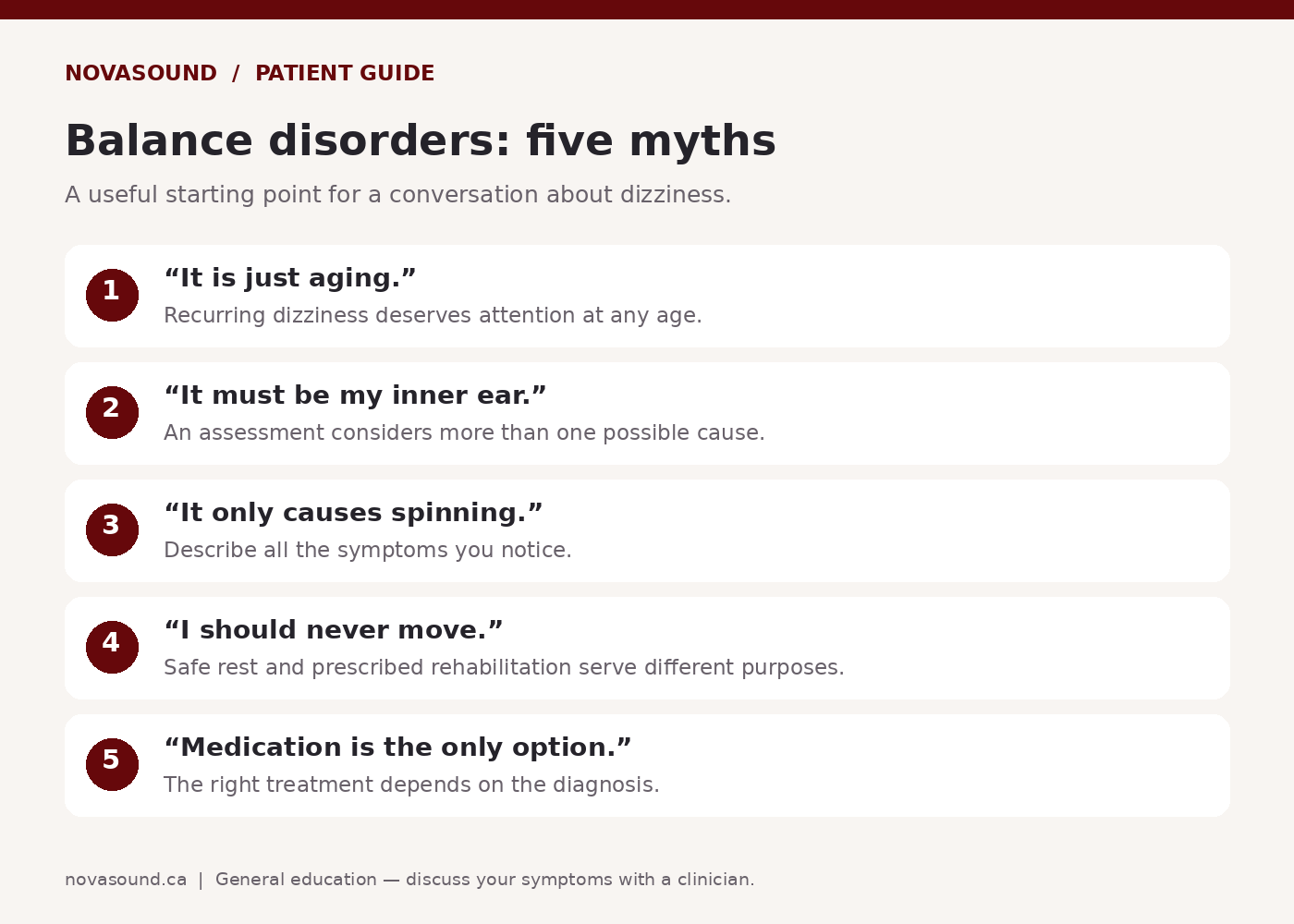
Myth: Dizziness Is Just a Normal Part of Aging
Fact: While balance issues can become more common as we age, dizziness is not something you have to simply accept.
Many vestibular disorders are treatable, and with proper diagnosis and therapy, treatment may help improve symptoms and daily function; results depend on the cause.
Myth: Dizziness Is Always Related to the Inner Ear
Fact: Dizziness can arise from many causes, including cardiovascular issues, medications, neurological conditions, or anxiety.
That is why a comprehensive evaluation, like the vestibular assessment we offer, is essential to identify the root cause.
Myth: Vestibular Disorders Only Cause Dizziness
Fact: Vestibular disorders can affect more than just balance.
Symptoms may include nausea, headaches, hearing changes, tinnitus, difficulty concentrating, and feeling mentally “foggy.”
Myth: You Should Avoid Moving When You Feel Dizzy
Fact: While it might feel natural to stay still, movement is often part of the treatment.
Vestibular rehabilitation exercises gradually retrain your brain to compensate for balance problems, improving stability and reducing dizziness over time.
Myth: All Dizziness Treatments Involve Medication
Fact: Medication can help manage symptoms, but many effective treatments for vestibular disorders focus on physical therapy, lifestyle changes, and specific maneuvers such as the Epley maneuver for BPPV.
At Novasound, we prioritize personalized, non-pharmacological treatment options whenever possible.
Why Knowing the Truth Matters
Understanding what causes dizziness and balance issues — and what does not — empowers you to seek the right care and avoid unnecessary worry.
Early diagnosis and tailored treatment can help you get back to the activities you love, safely and confidently.
Understanding Dizziness and Balance Disorders
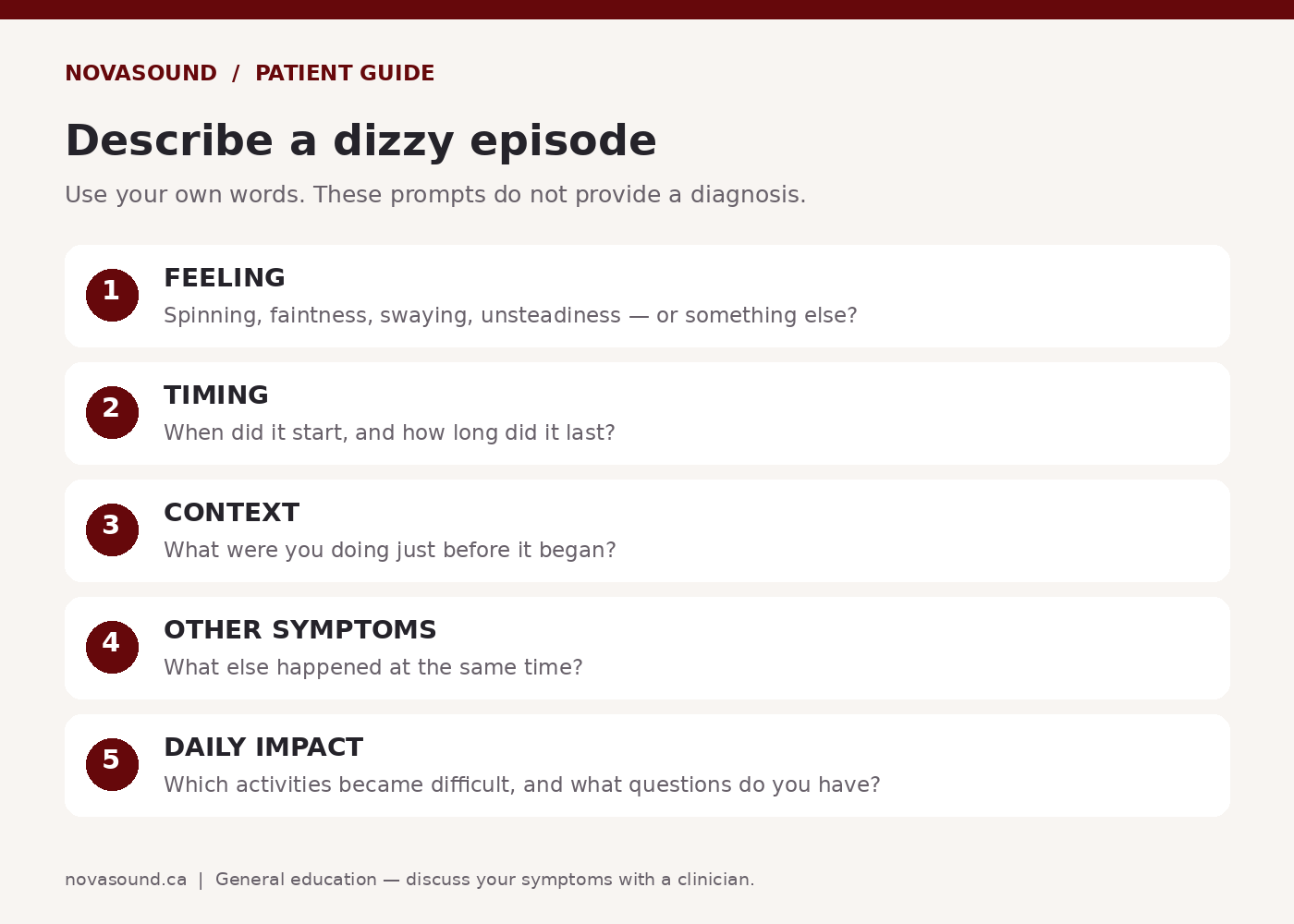
Dizziness and balance disorders describe symptoms and conditions, rather than one diagnosis. The word “dizzy” might mean spinning, feeling faint, or being unsteady. Explaining your own experience is more useful than choosing a label from an online article. Tell your clinician what happens, how long it lasts, and what you were doing when it started.
Preparing for a Balance Assessment
Before an appointment, write a short description of a typical episode in your own words. For example: “When I roll over in bed, the room seems to move,” or “I feel faint after standing up.” These are examples to help describe symptoms, not a way to diagnose yourself. Bring your questions so you can discuss what matters most to you.
- When did the symptoms begin, and how often do they happen?
- Does an episode last seconds, minutes, hours, or longer?
- Do you notice hearing changes, ringing in your ears, or a headache at the same time?
- Have you fallen, nearly fallen, or changed your routine because of the symptoms?
- Which medicines and supplements do you currently take?
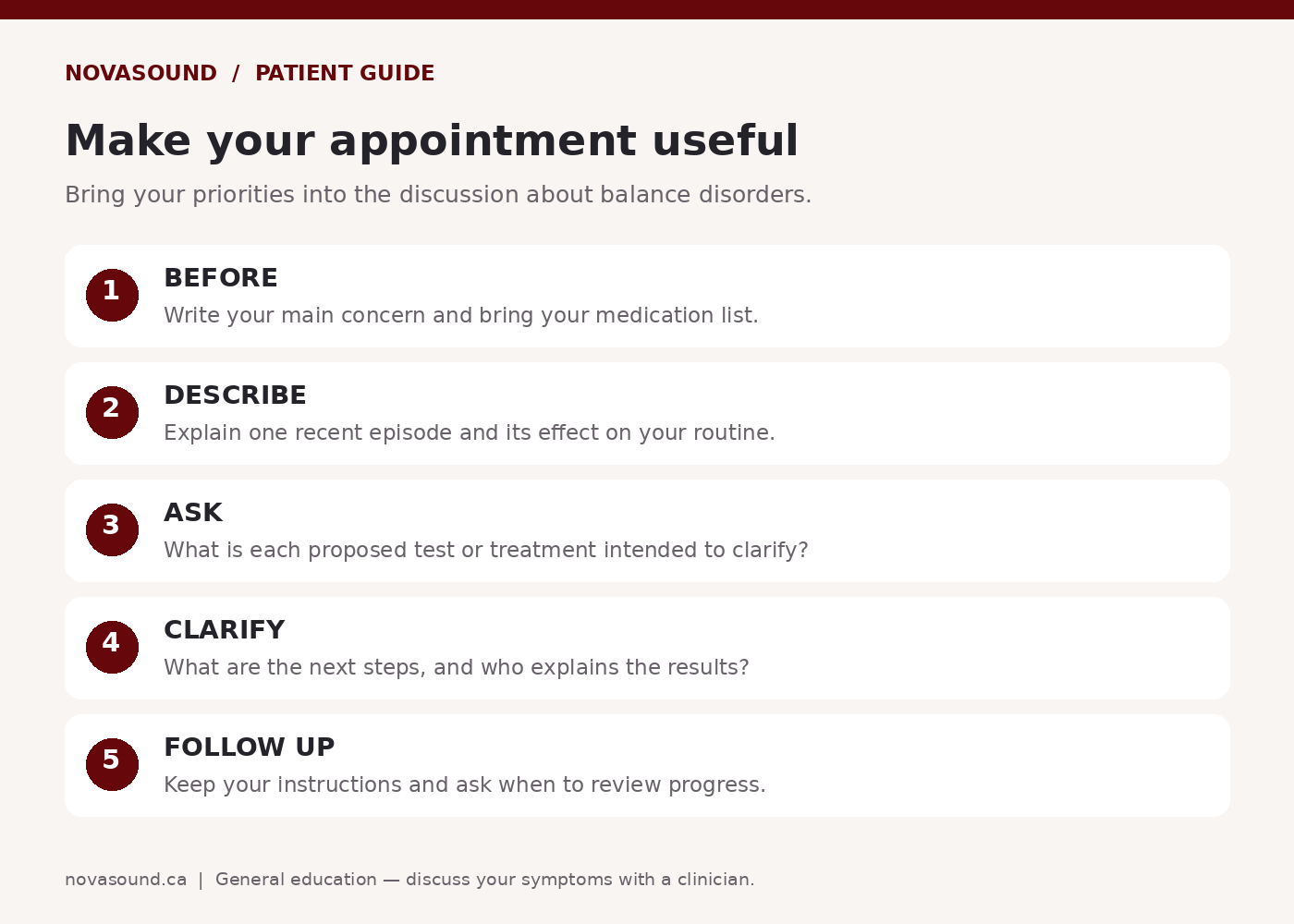
For dizziness and balance disorders, the assessment and next steps depend on the history and findings. Ask what each recommended test is intended to clarify. You can also ask who will explain the results, whether a referral is appropriate, and how progress will be reviewed. Keep a copy of your questions and any instructions you receive.
Questions About Dizziness and Balance Disorders
Are dizziness and vertigo the same?
Vertigo is a sensation that you or your surroundings are spinning or moving. Dizziness is a broader term that can also describe faintness or unsteadiness. Use the description that best matches your experience when speaking with a healthcare professional.
Should I rest or exercise?
During a dizzy spell, sit or lie down safely and get up slowly after it passes. Avoid driving, ladders, or machinery while dizzy. Rehabilitation is different from pushing through an unexplained episode: ask a clinician whether a tailored movement programme is suitable for you.
When should I arrange an appointment?
If dizziness persists, keeps returning, or worries you, seek medical assessment. Mention any accompanying hearing, vision, or other changes. Do not assume a recurring problem is simply age or try to identify its cause from a list of symptoms alone.
What should I ask about my treatment plan?
Ask what the working diagnosis means, which options are appropriate, and what the next step will be if symptoms continue. Discuss your goals, such as returning to a favourite activity or feeling more confident in daily routines. Clarify whom to contact if your situation changes before your follow-up.
Why Similar Symptoms Can Need Different Care
Learning about balance disorders is easier when you separate three questions: what does the symptom feel like, what might be causing it, and what should happen next? A spinning sensation is a description. BPPV is one possible diagnosis. A repositioning manoeuvre is one possible treatment after assessment. These words belong to different parts of the conversation and should not be treated as interchangeable.
BPPV: a positional cause of vertigo
Benign paroxysmal positional vertigo, or BPPV, is an inner-ear condition in which tiny calcium particles move out of their usual location. Changes in head position can then trigger a sensation of spinning. Rolling over in bed, looking upward, or moving between lying and sitting may bring on symptoms. Some people also feel unsteady between episodes.
BPPV is one example of why balance disorders do not always require medication. A trained clinician can assess whether positional vertigo fits the history and examination, including the pattern of eye movements during a positional test. If BPPV is confirmed, an appropriate repositioning manoeuvre may help. The choice depends on the affected canal and clinical findings. Symptoms can recur, so ask what to do if they return.
Do not use a description of BPPV as a diagnosis for every episode of dizziness. Other conditions can overlap. Johns Hopkins Medicine explains BPPV and its assessment.
Vestibular migraine: symptoms without a simultaneous headache
Vestibular migraine can involve vertigo, imbalance, nausea, motion sensitivity, and sensitivity to visual stimulation. A headache does not have to occur at the same time as the balance symptoms. A history of migraine or motion sensitivity can be relevant to the assessment. This is another reason to mention more than the sensation of spinning when discussing balance disorders.
Vestibular migraine can resemble or coexist with other conditions, including BPPV and Ménière’s disease. Identifying the cause requires a clinical assessment rather than a symptom checklist. Treatment may involve a discussion of migraine management, regular routines, triggers, and medication when appropriate. Tell your clinician about previous headaches, even if they were years ago, and ask how that history affects the evaluation.
Read the Johns Hopkins overview of vestibular migraine for further background.
What Tests for Balance Disorders Can Clarify
There is no single test that explains every dizzy symptom. Balance tests examine different aspects of the system, and the clinician chooses tests according to the history and examination. Eye-movement recording, for example, addresses a different question from a test of steadiness while standing. A hearing assessment may also be relevant when hearing symptoms accompany balance disorders.
- VNG or ENG: records eye movements that can help assess vestibular function.
- Video head impulse testing: examines eye responses during brief head movements.
- VEMP testing: measures muscle responses associated with stimulation of particular vestibular pathways.
- Posturography: measures balance while standing under different conditions.
These are examples of tests used in clinical care, not a promise that you need every test or that every clinic offers each one. Some tests can briefly provoke dizziness or nausea. Ask about preparation and transport home. Do not stop prescribed medication unless the responsible healthcare professional tells you to. MedlinePlus describes balance tests and preparation.
How Rehabilitation for Balance Disorders Is Individualized
Vestibular rehabilitation is an exercise-based approach designed around the problems identified during assessment. Depending on the findings, it may involve gaze stability, balance training, or carefully selected exposure to movements and visual situations that provoke symptoms. The aim is to improve function through an appropriate, personalized programme rather than to use the same routine for everyone.
Rehabilitation for balance disorders also considers daily activities and the person’s goals. An exercise that is suitable for one person may be unsuitable for another. BPPV, for example, may need a specific repositioning procedure rather than a general exercise programme to address its positional spinning. Ask why each exercise has been selected, how it should feel, and when to contact your therapist.
Recovery is influenced by the underlying condition and individual circumstances. Request clear instructions about exercise frequency, support, progression, and review. Do not copy a difficult balance challenge from a video without knowing whether it is appropriate. The Vestibular Disorders Association explains tailored rehabilitation.
When Dizziness Needs Prompt Medical Attention
Reading about balance disorders should never delay urgent assessment. Vertigo with new trouble speaking, arm or leg weakness, double vision, or loss of vision needs emergency medical attention. Seek urgent medical advice for vertigo with a severe headache or significant vomiting. New hearing loss with vertigo also needs prompt assessment. Do not drive yourself when your symptoms make driving unsafe.
These examples are not a complete triage checklist. If you are unsure how urgently you need help, contact an appropriate local medical service. A routine appointment for balance disorders is different from emergency assessment of a sudden concerning change. See the NHS guidance on vertigo and warning symptoms.
A Practical Symptom Diary for Balance Disorders
A short diary can give structure to your appointment without turning it into an assignment. You do not need a technical vocabulary or a perfectly complete record. Choose a format you are comfortable with, such as a notebook or a note on your phone. Record what you experienced rather than what you think the diagnosis should be.
Example: recording the episode
Consider this fictional note: “Tuesday morning, after getting out of bed, I felt unsteady and sat back down. I am not sure whether it was spinning or faintness. I would like help describing it.” That is a useful starting point for a conversation. Uncertainty is worth recording; it is more honest than choosing a medical label that does not quite fit.
For a later entry, you might add: “I noticed the same feeling during a different activity. I want to explain what was similar and what was different.” The purpose is to capture your experience of possible balance disorders, not to test yourself or deliberately bring on symptoms. Leave blanks when you do not remember. Approximate timing can be labelled as approximate.
Example: explaining the impact
Try completing this sentence: “The activity I most want to discuss is ___, because ___.” You might want to ask about moving around your home, a work task, an outing, or another part of your routine. Describe what feels difficult and what you would like the clinician to help you understand. You do not need to rate yourself against somebody else’s recovery.
If someone accompanies you, ask whether they can help remember your questions. They can describe what they observed, while you describe what you felt. Those are different perspectives. Make it clear which observations are yours and which came from another person. Bring the notes into the conversation rather than assuming the clinician has already seen them.
Planning a Useful Follow-Up for Balance Disorders
Before the appointment ends, try writing a brief summary in your own words. For example: “My understanding is that the next step is ___, and I should contact ___ if I have a question.” Ask the clinician to correct anything you misunderstood. This gives you a practical record of the plan rather than a collection of unfamiliar terms.
Ask about the purpose of each next step
If another appointment or referral is suggested, ask what question it is intended to answer. If a treatment is proposed, ask what improvement it is meant to support and how the result will be reviewed. For balance disorders, it is helpful to distinguish the assessment stage from a confirmed treatment plan. Write down any uncertainty that still needs to be resolved.
Keep your own priorities visible
You might bring two lists: “What I want to understand” and “What I want to be able to do.” The first could include questions about the assessment, while the second focuses on your routine. Put your most important concern first. A clear personal priority can help make the discussion useful even when the diagnostic process takes more than one appointment.
Prepare for the review conversation
At follow-up, describe what has changed since the last visit and what remains difficult. Refer to the instructions you were given, and explain anything that was unclear or hard to fit into your routine. Ask what should happen next. Care for balance disorders should leave room for questions and clarification rather than requiring you to guess what a result means.
Your Appointment Checklist
Use this checklist as a conversation aid. It is not a self-test for balance disorders, and checking an item does not indicate a diagnosis. Keep only the prompts that are useful to you; a concise page is often easier to discuss than a long document that hides your main concern.
- Write the question you most want answered.
- Describe one recent episode using everyday words.
- Note the timing and context as accurately as you can.
- Bring your current medication and supplement list.
- List relevant questions about hearing or other accompanying symptoms.
- Ask how any recommended testing relates to your symptoms.
- Clarify the next step, review plan, and contact for questions.
To arrange a discussion of dizziness and balance disorders in Halifax, contact Novasound using the details below. When booking, describe your main concern and ask which appointment is appropriate. If you have preparation or accessibility questions, raise them in advance so you know what to expect. For sudden warning symptoms, seek medical help promptly instead of waiting for a routine booking.
Learn More and Find Care in Halifax
For a starting point, explore our vestibular tests and treatments and read facts about your vestibular system. Bring questions about dizziness and balance disorders to your appointment so the conversation focuses on your symptoms and priorities.
Patient information: NIDCD: Balance Disorders and NHS: Dizziness. This article provides general education; an individual assessment is needed for diagnosis and treatment.
Book Appointment
Ready to take the next step?
Novasound Hearing & Balance Center
#22, 2625 Joseph Howe Drive, Halifax, NS
Phone: 902-444-7788
Email: info@novasound.ca