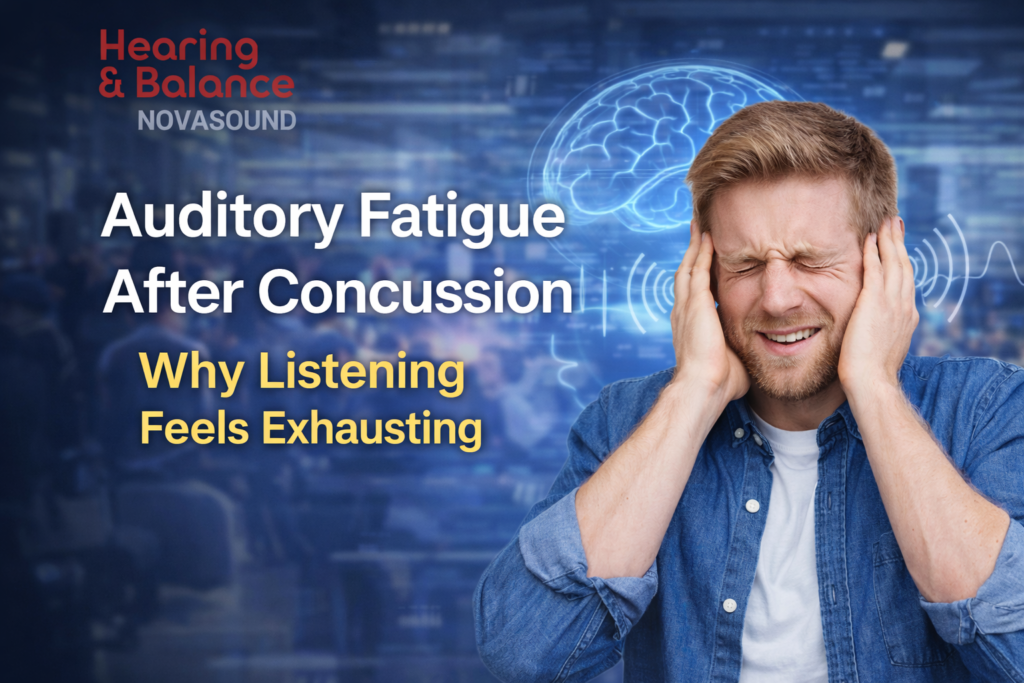

Auditory Processing Disorder After Concussion
Understanding Post-Concussion APD
Auditory processing disorder after concussion can affect everyday listening. Auditory processing disorder (APD) is not just something seen in children. Adults who have sustained a concussion or head injury may also experience long-term difficulties in how their brain interprets sounds.
While their hearing may test as normal, they can struggle to process verbal information, particularly in noisy environments or complex listening situations.
Understanding Post-Concussion APD
After a concussion, the brain’s ability to decode and organize sound can be disrupted.
This can lead to challenges such as:
- Trouble focusing on one voice in a crowd
- Difficulty following fast conversations
- Mishearing similar words
- Feeling overwhelmed by background noise
- Increased listening effort and fatigue
For musicians, teachers, healthcare workers, and anyone who relies heavily on auditory input, these issues can significantly affect work, relationships, and daily life.
A recent article from CBC News shares the firsthand experience of an Ottawa woman who struggled with undiagnosed APD after a concussion, highlighting how disruptive and isolating these challenges can be.
Read the CBC article here
5 Signs of Auditory Processing Disorder After Concussion
- Asking people to repeat themselves often
- Trouble understanding speech over the phone or in noisy places
- Difficulty localizing where sounds are coming from
- Sensitivity to loud or complex environments
- Feeling mentally drained after long conversations or meetings
Impact on Daily Life
Even when hearing thresholds are normal, auditory processing disorder after concussion can make social interactions and work tasks exhausting.
Individuals may avoid group settings, withdraw from conversations, or feel frustrated by frequent misunderstandings. Over time, this can affect confidence and quality of life.
Assessment of Auditory Processing Disorder After Concussion
An audiologist specializing in APD can perform a comprehensive auditory processing evaluation that goes beyond standard hearing tests.
This assessment identifies specific challenges in:
- Competing or degraded speech
- Rapid speech understanding
- Binaural integration processing input from both ears
- Temporal processing timing of sounds
At Novasound Hearing & Balance Center, we offer specialized evaluations to pinpoint how a concussion has impacted auditory processing and tailor recommendations to each individual’s needs.
Support for Auditory Processing Disorder After Concussion
Management is individualized. The approaches below may help with everyday communication, but benefits vary and no single programme is appropriate for everyone.
1. Assistive Technologies
- Remote microphones and FM/DM systems to improve speech clarity
- Noise-cancelling devices or apps for high-noise environments
2. Auditory Training
- Exercises and computer-based programs to strengthen processing skills
- Working with speech-language pathologists on auditory memory, attention, and discrimination
3. Environmental Modifications
- Reducing background noise at home and work
- Using visual supports and written instructions
- Strategic seating in meetings or social settings
4. Counselling and Education
- Helping individuals and families understand APD’s impact
- Teaching compensatory techniques and advocating for accommodations
Living With Auditory Processing Challenges After Concussion
Recovery from a concussion is different for every individual, and auditory processing difficulties may not always appear immediately after the injury.
Some people notice challenges weeks or even months later as they return to work, social environments, or demanding listening situations. Recognizing these changes early can help prevent frustration and reduce long-term communication barriers.
Developing awareness of listening triggers — such as crowded spaces, rapid conversations, or background noise — allows individuals to apply practical coping strategies and seek appropriate professional support.
With proper evaluation, personalized recommendations, and ongoing guidance from audiology specialists, many people experience significant improvement in confidence, communication clarity, and overall quality of life.
Preparing for an Assessment of Auditory Processing Disorder After Concussion
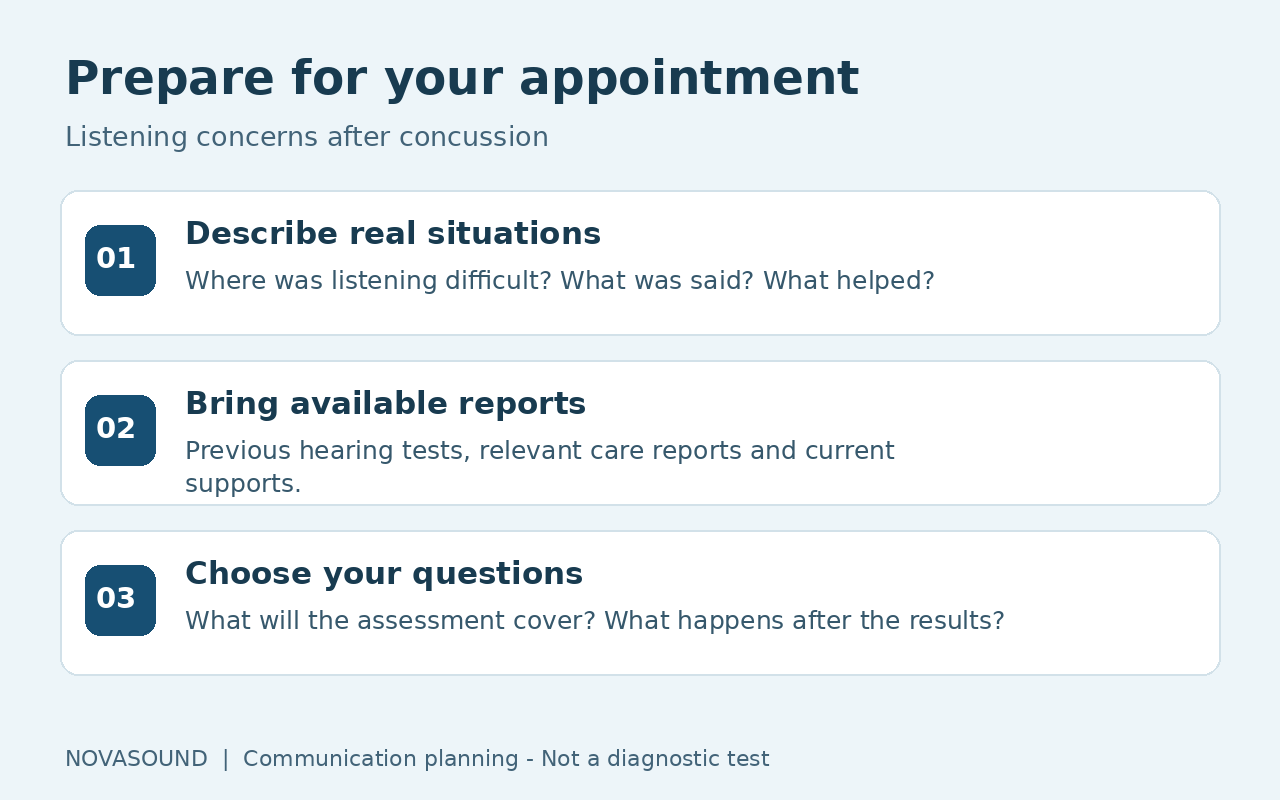
A short account of everyday listening can make an appointment easier to use. You do not need to identify the cause yourself or collect a perfect record. Start with the situations that matter most to you and the questions you would like the assessment to answer.
Describe a specific situation
Instead of writing only “I cannot hear properly,” describe what happened. For example: “In a team meeting, I could hear people speaking but lost track when two colleagues talked at once.” Include where you were, whether the speaker was nearby, and what made the conversation easier or harder. This is an observation to discuss, not evidence that confirms a diagnosis.
Include an occasion when communication went well. If a quiet one-to-one conversation felt manageable while a group discussion did not, say so. Your clinician can use the contrast when asking further questions. There is no need to deliberately recreate an uncomfortable listening situation to collect examples.
Bring relevant information
- Previous hearing-test reports and any existing communication recommendations.
- Available reports from the professionals involved in your concussion care.
- A brief account of when you first noticed the listening change.
- A list of current communication supports and what you think of them.
- The three questions you most want answered during the visit.
Tell the clinic in advance about language or accessibility needs. Ask which records they require and whether someone who knows your everyday communication difficulties can attend with you. If a report is unavailable, explain the gap rather than delaying a conversation simply to build a complete file.
Ask how the appointment will work
Useful questions include how long to allow, what the first appointment covers, and how the clinician decides which tests are appropriate. Mention concerns about completing the appointment and ask how these can be accommodated. Follow the clinic’s individual preparation instructions rather than changing medicines or routines on your own.
Auditory Processing Disorder After Concussion: Questions About Your Results
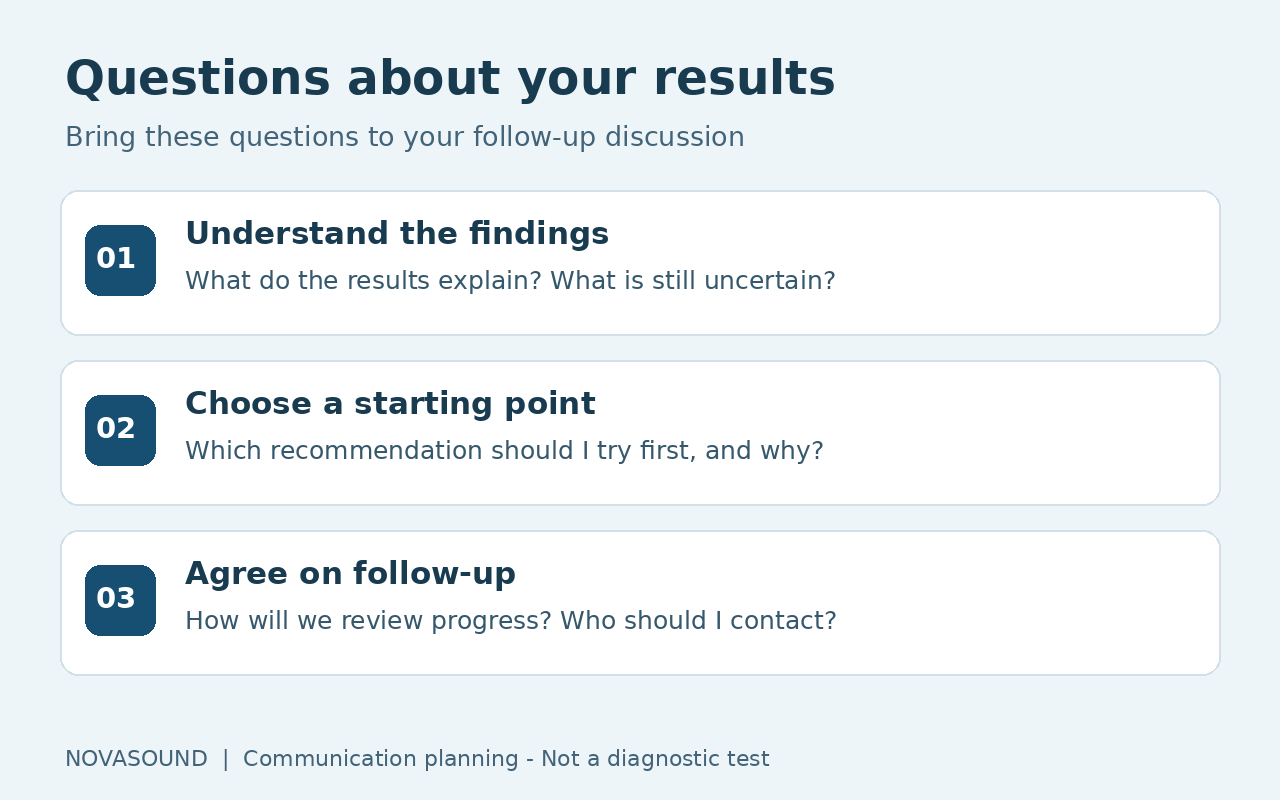
An assessment report should help connect findings with everyday communication. If the report contains unfamiliar terms, ask for a plain-language explanation. It is reasonable to ask which findings are clear, which remain uncertain, and whether another professional needs to contribute to the assessment.
- What do the results explain about the situations I described?
- Were any tests affected by other difficulties or by the testing conditions?
- Do I need further hearing, communication or other assessment?
- Which recommendation should I try first, and what is its purpose?
- How will we decide whether that recommendation is useful?
- When should we review the plan, and who should I contact with questions?
Ask for written recommendations you can revisit after the appointment. If a device or programme is suggested, clarify its cost, practical demands, expected purpose and review arrangements before committing. A recommendation should make sense in the places where you actually need to communicate.
Everyday Communication With Auditory Processing Disorder After Concussion
The following examples illustrate communication adjustments you can discuss with your clinician. They do not diagnose APD or replace a concussion rehabilitation plan. Choose an adjustment relevant to your own difficulties, rather than trying to introduce every suggestion at once.
At home
For an important conversation, agree on a place where you can face each other and reduce competing sound. A family might pause the television while discussing an appointment, give one piece of information at a time, and write down the final arrangement. The goal is to make the message easier to share, rather than continually testing whether somebody remembers it.
Agree on a comfortable way to ask for clarification. “Please say the last step again” or “Could you write the address down?” tells the speaker what would help. Family members can ask which approach works best rather than assuming that speaking louder will resolve every misunderstanding.
At work or in education
Identify the communication task that causes the greatest difficulty. It might be a fast discussion, a telephone call or spoken instructions given while another task is underway. Bring that example to the professional supporting your return to work or study and ask which adjustments suit your wider recovery plan.
Possible arrangements to discuss include a written agenda, one speaker at a time, a brief written summary of decisions and an agreed way to request clarification. If a meeting produces an action list, ask for names and deadlines to be written clearly. These are examples of making information accessible, not a prescribed schedule for returning to duties.
During telephone and video calls
Before an important call, write down its purpose and the questions you need answered. Ask the other person to confirm important details in writing when possible. For a video meeting, captions or a chat summary may be worth discussing, but check important names, dates and instructions because automatic captions can contain mistakes.
If you miss part of the conversation, identify the missing point rather than feeling obliged to agree. You might say, “I heard the date, but could you repeat the location?” A short written confirmation can help both people check that they have understood the same arrangement.
In social settings
Tell a trusted friend which part of a gathering is difficult and what support you prefer. For example, you could ask to continue an important conversation in a quieter spot or speak with one person at a time. Make choices that fit your current care plan and comfort rather than treating attendance at a noisy event as a test of recovery.
When arranging a meal or gathering, discuss the setting beforehand. A simple message such as “I would like to join you; could we choose somewhere where conversation is easier?” gives others something practical to respond to. You do not have to disclose your entire medical history to explain a communication preference.
Auditory Processing Disorder After Concussion: An Everyday Example
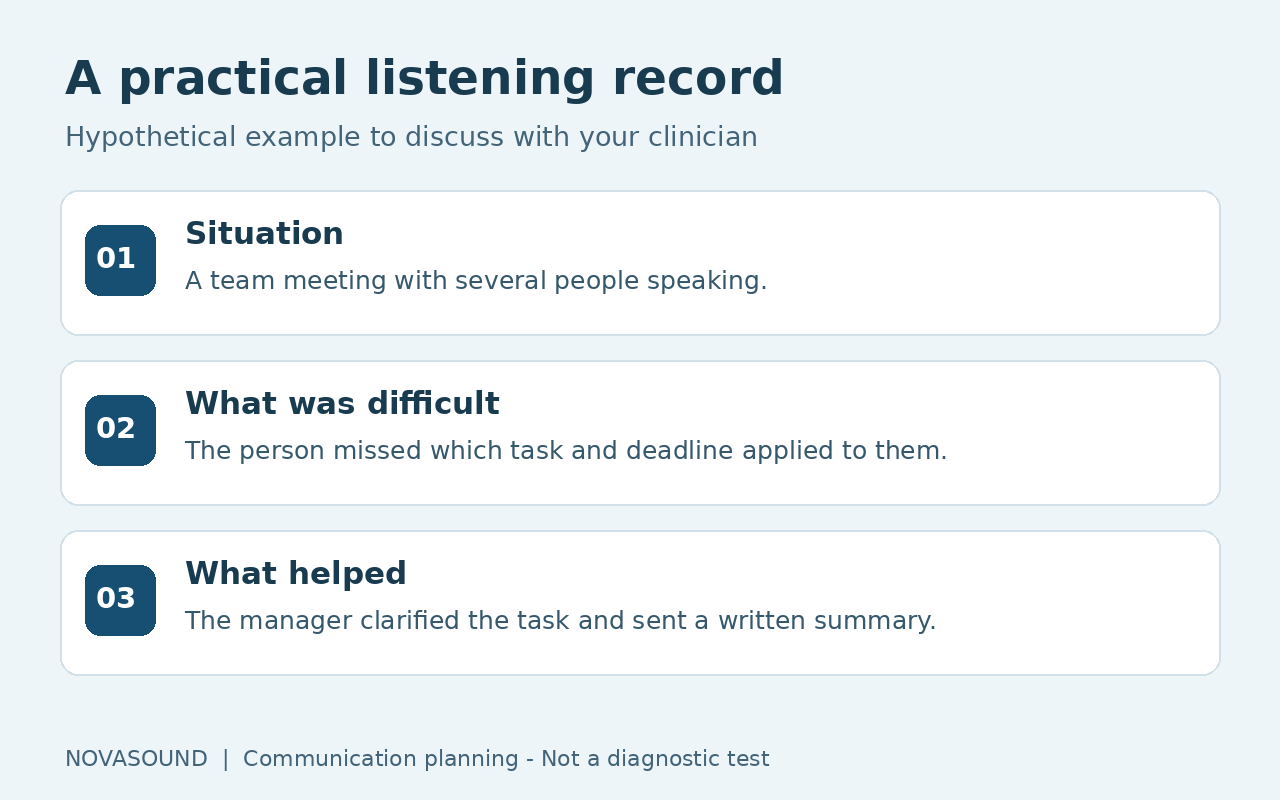
Imagine a person who follows a quiet conversation comfortably but loses parts of a group meeting. Afterward, they are unsure which task belongs to them. This hypothetical example does not establish APD: an assessment is needed to explore the explanation.
A useful description would record the setting, what the speaker said, which part was missed and what helped. For instance: “Several people were discussing different deadlines. I missed my assignment, but understood it when my manager repeated it separately and emailed the task.” That account gives the clinician a concrete communication problem to investigate.
The same person might ask the workplace to provide a written action list while their care team assesses the concern. At follow-up, they can explain whether the arrangement made instructions easier to check. The purpose is to improve a meaningful activity and share useful observations, rather than to use the adjustment as proof of a particular disorder.
Reviewing Support for Auditory Processing Disorder After Concussion
Support for auditory processing disorder after concussion should connect with your own priorities. Choose a goal you can describe plainly, such as understanding the decisions from a short meeting or following a family discussion about appointments. Ask the clinician how to judge progress without turning every conversation into a formal test.
Keep any notes brief and useful. Record the situation, the support tried and your view of the outcome. Include difficulties with putting the recommendation into practice. A strategy that is too expensive, unavailable at work or hard to use needs discussion; it should not simply be labelled a failure by the person trying it.
Before a review, prepare one example of something that became easier and one example that remains difficult. Ask whether the plan needs adjusting and whether recommendations from different professionals fit together. Share reports with relevant people according to your preferences and the arrangements agreed with your care team.
Frequently Asked Questions About Auditory Processing Disorder After Concussion
Can a standard hearing test be normal?
Yes. A person can report difficulty understanding speech despite normal or near-normal hearing thresholds. A standard hearing test and an assessment of complex listening answer different questions. Explain your real-life concerns so that the audiologist can decide whether further assessment is appropriate.
Do these five signs mean I have APD?
No. Listening complaints after a head injury may overlap with attention, memory, language and other difficulties. The signs in this article can help start a discussion, but they cannot determine a diagnosis or show that one particular problem is responsible.
Does every concussion cause an auditory processing disorder?
No. Having a concussion does not by itself establish APD. The reason for assessment is a person’s reported difficulties and clinical history, considered with appropriate test findings. Avoid assuming that somebody else’s diagnosis or recovery experience will be the same as yours.
Should I buy equipment before an assessment?
Ask a qualified clinician what, if anything, is suitable for your needs. Before buying equipment, clarify which communication problem it is intended to address, how it will be used, what it costs and whether a trial or follow-up is available. A general article cannot determine which device is appropriate for an individual.
Can someone attend the appointment with me?
Ask the clinic about its arrangements. If you want a family member or support person involved, explain whether you would like help describing everyday situations, taking notes or reviewing recommendations. Your own account and preferences should remain central to the discussion.
What if the results do not explain everything?
Ask what remains uncertain and which next step is appropriate. Audiology findings form part of the broader picture after a concussion. Further assessment or coordination with your existing care team may be needed; a useful consultation should explain the limits of the findings as well as the recommendations.
Professional Resources and Further Reading
The American Speech-Language-Hearing Association provides professional guidance on central auditory processing disorder and traumatic brain injury in adults. These resources explain the roles of assessment, individualized management and collaboration between professionals.
For information about local services, explore auditory processing disorder services in Halifax. Contact the clinic to ask about your specific concerns and appointment requirements. This article provides general information and does not replace an individual clinical assessment.
A Short Checklist Before Contacting the Clinic
Choose the concern you want to describe first. You might write a sentence about a meeting, a phone call or a conversation at home. Then add the question you want answered: whether a hearing assessment is needed, what the appointment involves or which previous reports to bring. This makes an initial enquiry focused and easier for the clinic to respond to.
Before the appointment ends, check that you understand the next action, who is responsible for it and how to arrange follow-up. If you receive several recommendations, ask which one is the starting point. You can also ask for a copy of the plan in an accessible format and confirm whom to contact if something is unclear. A practical plan should leave you knowing what happens next without requiring you to interpret technical terms alone.
How Novasound Can Help
If you’ve experienced a concussion and now notice difficulty processing sounds, you don’t have to struggle alone.
At Novasound Hearing & Balance Center, we specialize in assessing and supporting individuals with APD, including those affected by brain injury.
We work closely with patients to create personalized care plans that address their specific listening challenges and help them regain confidence in communication.
Let’s Take the Next Step Together
Early evaluation and targeted support can make a world of difference in managing auditory processing disorder after concussion.
Contact Novasound Hearing & Balance Center today to schedule your comprehensive assessment and start your journey toward better hearing and balance.
Ready to take the next step?
Book Appointment
#22, 2625 Joseph Howe Drive, Halifax, NS
Phone: 902-444-7788