A REAL EXAMPLE FROM OUR CLINIC
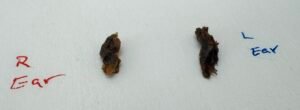
Figure 1. Cerumen removed from both ears of a 4-year-old child seen at Novasound Hearing & Balance Center.
At our clinic, we recently saw a 4-year-old child with significant earwax (cerumen) buildup in both ears. As shown above, the cerumen was significantly occluding both ear canals, reducing the clarity and intensity of sound reaching the auditory system.
This is more common than many parents realize—and often overlooked.
Why earwax matters more in children
Earwax itself is normal and protective. However, when it becomes impacted or occluding, it can act like a physical barrier to sound.
In young children, even a mild reduction in sound clarity can have a bigger impact than in adults because:
- Their brain is still developing listening pathways
- Speech and language are actively forming
- Learning relies heavily on hearing clearly (especially in noise)
What happens when sound is partially blocked?
When earwax blocks sound, the child may experience:
- Muffled hearing (like listening underwater)
- Missing parts of speech sounds
- Increased listening effort
- Reduced attention to verbal instructions
Over time, this can lead to inconsistent auditory input to the brain.
The connection to listening and learning difficulties
If reduced hearing (even temporary) happens repeatedly during early development, it may contribute to:
- Speech and language delays
Children may not hear speech clearly enough to fully learn sound patterns.
- Auditory processing challenges
The brain may struggle to:
- Distinguish similar sounds
- Understand speech in noise
Follow multi-step instructions
- Classroom difficulties
Parents and teachers may notice:
- “Not listening” or needing repetition
- Trouble following directions
- Fatigue during listening tasks
- Falling behind in reading or phonics
Important clarification
Earwax does not directly cause Auditory Processing Disorder (APD).
However, reduced or inconsistent auditory input during critical developmental periods may:
- Exacerbate listening difficulties
- Mask underlying processing issues
- Delay identification of true APD
Signs parents should watch for
- Frequently saying “what?”
- Turning up volume more than expected
- Not responding when called
- Speech that is unclear for age
- Difficulty hearing in noisy places
- Complaints of “blocked” ears
The good news: it’s manageable
The impact of earwax is often reversible once removed.
At Novasound Hearing and Balance Center, we:
- Safely assess and remove earwax
- Check hearing immediately after
- Monitor listening development
- Provide guidance if further evaluation is needed
When should a child be checked?
We recommend an audiology check if:
- There are listening or speech concerns
- The child has a history of wax buildup
- Teachers report attention or listening issues
- There is frequent ear discomfort or blockage
Final thought
Sometimes, something as simple as earwax can quietly affect how a child hears the world.
Early identification and management can make a meaningful difference in listening, learning, and confidence.
Ready to take the next step?
Book Appointment
#22, 2625 Joseph Howe Drive, Halifax, NS
Phone: 902-444-7788