
APD in adopted children can raise questions for families trying to understand listening and learning difficulties. Every child comes to adoption with a unique life story. While many adopted children thrive, some experience challenges with listening, attention, language, or learning that may not be immediately obvious. One possible contributor is Auditory Processing Disorder (APD).
It is important to understand that adoption itself does not cause APD. However, some children who have been adopted may have experienced medical or developmental factors before or shortly after birth that can increase the likelihood of auditory processing difficulties.
Understanding these challenges early can help children receive the right support and succeed both at home and in school.
Understanding APD in Adopted Children
Auditory Processing Disorder is a condition in which the ears detect sound normally, but the brain has difficulty interpreting and organizing what is heard.
Children with APD usually have normal hearing on a standard hearing test but may struggle to:
- Understand speech in noisy classrooms
- Follow multi-step verbal instructions
- Remember spoken information
- Tell similar-sounding words apart
- Keep up with classroom discussions
- Learn through listening alone
These difficulties can affect academic performance, confidence, and communication.
APD in Adopted Children: Medical and Developmental History
An assessment of APD in adopted children should consider each child’s history without making assumptions about adoption. Some medical factors are associated with auditory processing difficulties; other experiences may affect language or attention without indicating APD.
Relevant history to discuss with the assessment team includes:
Prenatal Factors
- Premature birth
- Low birth weight
- Prenatal alcohol exposure
- Prenatal drug exposure
- Maternal illness during pregnancy
- Poor prenatal nutrition
Early Childhood Factors
- Recurrent middle-ear infections during infancy
- Untreated hearing problems
- Limited access to healthcare
- Frequent changes in caregivers
- Early institutional care
- Limited language exposure during critical developmental periods
Stress and Trauma
Chronic stress or early adversity can influence attention, memory, executive functioning, and language development. These difficulties should not automatically be labelled APD. A comprehensive assessment is important when symptoms overlap.
APD, ADHD, and Trauma: They Are Not the Same
When exploring APD in adopted children, clinicians also consider attention, language, learning, and emotional needs.
Although these conditions can occur together, they are different.
| APD | ADHD | Trauma-Related Difficulties |
|---|---|---|
| Difficulty processing spoken information | Difficulty sustaining attention | Difficulty regulating emotions and attention |
| Problems understanding speech in noise | Distractibility that affects more than one setting | May appear inattentive during stressful situations |
| Frequently asks for repetition | Misses information due to inattention | Listening may vary depending on emotional state |
| Hearing is typically normal | Hearing is typically normal | Hearing is typically normal |
A multidisciplinary evaluation may be needed to determine which factors are contributing to a child’s challenges.
10 Possible Signs of APD in Adopted Children
The following observations can guide a conversation with an audiologist. They are not a diagnostic checklist: similar difficulties have several possible explanations. A child may need further evaluation if they:
- Frequently say “What?” or “Huh?”
- Seem to hear but not understand
- Perform better in quiet environments
- Struggle with classroom listening
- Misunderstand spoken directions
- Have difficulty following conversations
- Need repeated instructions
- Become mentally fatigued after listening
- Experience reading or spelling difficulties despite normal intelligence
- Have stronger visual learning skills than auditory learning skills
How Is APD in Adopted Children Assessed?
An APD assessment begins with a comprehensive hearing evaluation to confirm that hearing sensitivity is normal or that any hearing loss has been appropriately addressed.
For children who meet the appropriate age and developmental criteria, specialized auditory processing tests may evaluate:
- Speech understanding in background noise
- Dichotic listening (processing information presented to both ears)
- Temporal processing (timing aspects of sound)
- Auditory discrimination
- Auditory memory and sequencing
Information from parents, teachers, speech-language pathologists, psychologists, and other professionals is often considered to provide a complete picture. Assessment of APD in adopted children should also account for the languages a child uses and their experience with the test language. Learning another language is not itself APD.
Can APD Be Treated?
Management of APD in adopted children is tailored to the child’s needs. Support can help with everyday listening, but outcomes vary and no single programme is suitable for everyone.
Treatment may include:
- Auditory training programs
- Classroom accommodations
- Remote microphone (FM/DM) technology when appropriate
- Environmental modifications
- Communication strategies for parents and teachers
- Collaboration with speech-language pathologists, psychologists, occupational therapists, and educators
Progress should be reviewed with the child, family, and school so that support can be adjusted when needed.
When Should Parents Seek an Assessment?
Consider speaking with an audiologist if your child:
- Has normal hearing but continues to struggle with listening
- Understands much less in noisy environments
- Is falling behind despite appropriate educational support
- Frequently misunderstands spoken instructions
- Has a history of developmental or medical risk factors that may affect auditory processing
Early identification helps families understand the reason behind listening difficulties and allows appropriate support to begin sooner.
Preparing for an Assessment of APD in Adopted Children
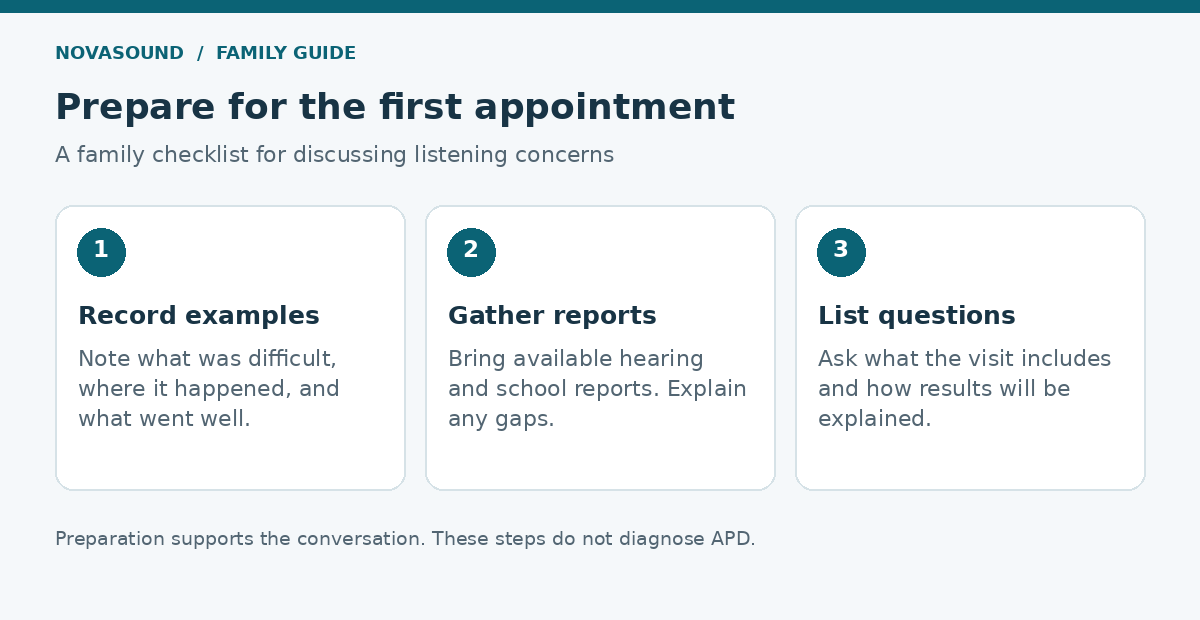
Parents asking about APD in adopted children often want to know what to bring to the first appointment about APD in adopted children. A short, organised account of everyday concerns can make the conversation more useful. The suggestions below are a practical way to prepare, rather than a test or a way to diagnose your child at home.
Write down a few specific listening examples
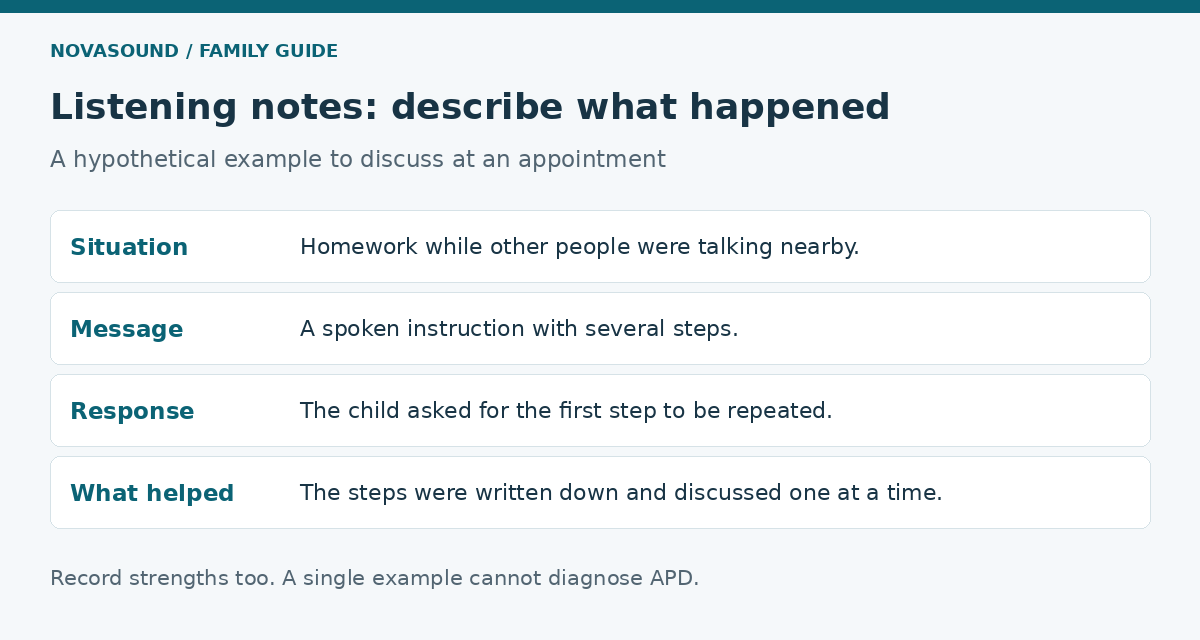
Choose three or four recent situations instead of trying to record every difficulty. Note what was said, where the conversation happened, and what your child did next. Include occasions when listening went well. For example: “During homework, my child followed one instruction in a quiet room, but asked for repetition when other people were talking nearby.” This describes an observation without deciding what caused it.
Useful details include whether the speaker was nearby, whether the child could see the speaker, whether the instruction had several steps, and whether unfamiliar words were involved. Ask your child how the experience felt. Their account may be different from an adult’s interpretation, and it deserves a place in the discussion.
Gather available records without worrying about gaps
Bring previous hearing-test reports, relevant school reports, and assessments already completed by other professionals. Make a brief list of current supports and the questions you most want answered. If early medical or developmental records are unavailable, say so. Families do not need to invent a complete history or make assumptions about a child’s experiences.
For a child who uses more than one language, explain when and where each language is used. Tell the clinician about changes in the language of schooling and any interpreter needs before the visit. When discussing APD in adopted children, an accurate description of the child’s present communication needs is more useful than labels based only on their background.
Ask the clinic practical questions in advance
- What does the first appointment include, and how long should we allow?
- Which previous reports would you like us to bring?
- How will you decide whether the available tests suit my child?
- Can we discuss breaks or other arrangements that may help my child participate?
- Will we receive a written explanation of the findings and recommendations?
- What are the fees, and what information should we check with our insurer?
These questions help set expectations; they do not imply that every clinic uses the same process. Let the team know about any concerns your child has about appointments so they can explain what to expect in an appropriate way.
School Support for APD in Adopted Children
Support for APD in adopted children works best when conversations focus on the individual child’s day-to-day needs. A school discussion can begin with one concrete difficulty, one existing strength, and one question. For example: “Group instructions are difficult, but written task lists seem helpful. Can we compare what happens in different lessons?” This gives the teacher something specific to observe.
Keep shared notes brief and respectful
A simple record can use four headings: situation, difficulty noticed, support tried, and the child’s response. For a hypothetical example, a teacher might record that a pupil asked for repeated instructions during a noisy group activity but completed a similar task when the steps were written down. That observation can inform a professional discussion; it does not establish APD.
There is usually no need to circulate a child’s full adoption history in a classroom email. Keep routine communication focused on relevant learning needs and discuss sensitive background information privately with the appropriate professional. Ask the child, in an age-appropriate way, what they would like adults to understand and what helps them ask for clarification.
Turn recommendations into a clear follow-up plan
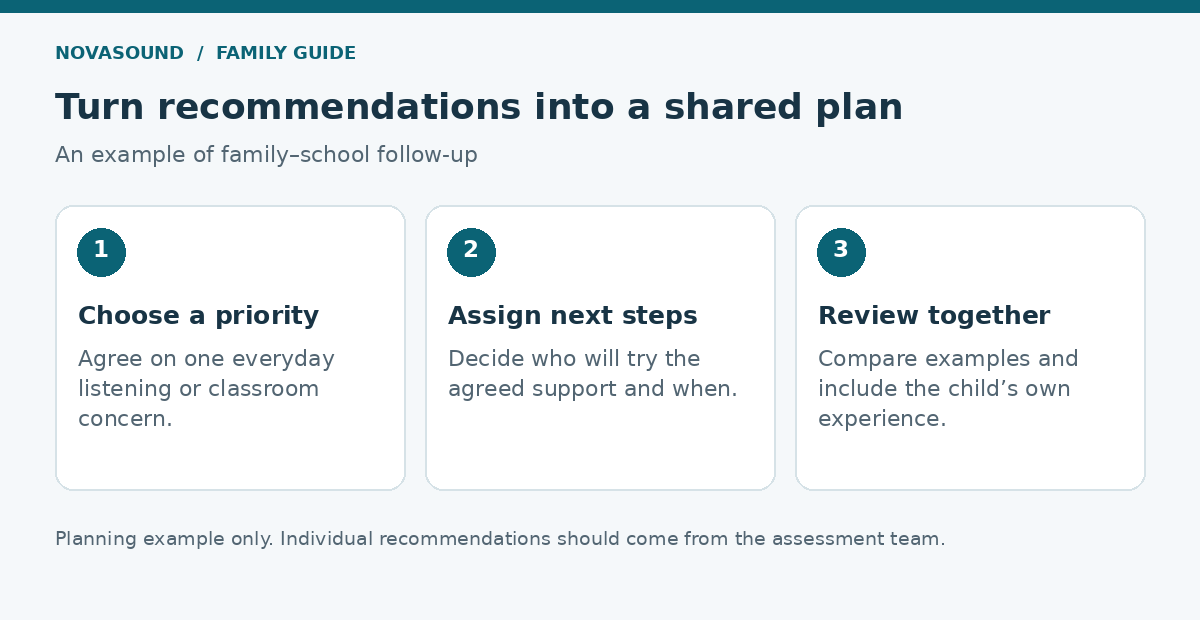
After an assessment for APD in adopted children, ask which recommendations should be prioritised, who will put them into practice, and when the family and school will review them. Agree on an everyday goal, such as understanding the first step of a classroom task, rather than expecting a single score to describe every aspect of progress.
At the review, compare concrete examples and listen to the child’s own experience. Discuss which arrangements were practical, which were difficult to maintain, and what still needs attention. If concerns continue, return to the assessment team with those observations. A plan for APD in adopted children should remain individual: another family’s experience can offer questions to ask, but it cannot determine the right assessment or support for your child.
Everyday Communication Tips for Families
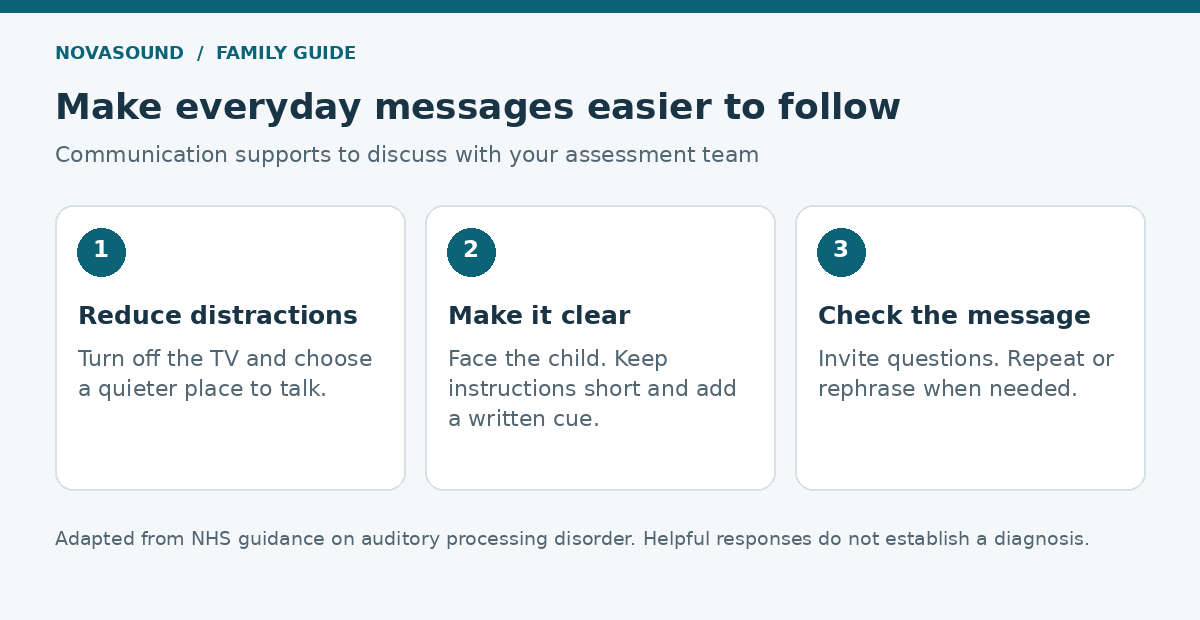
While a family is discussing APD in adopted children with an audiologist, everyday communication can be made easier to follow. The NHS guide to auditory processing disorder recommends face-to-face conversation, visual or written information, and repetition or rephrasing when needed. It also advises reducing background noise and avoiding long, complicated sentences.
At home, this might mean turning off the television before giving an instruction, keeping your face visible, and pairing a spoken reminder with a short written list. Use a natural speaking pace and check whether the message was understood. These are communication supports, not a home diagnostic test or a substitute for professional advice. A child who benefits from them does not necessarily have APD.
Make clarification an ordinary part of conversation
A child should be able to ask for help without feeling that they have done something wrong. Families can agree on a comfortable phrase, such as “Please say the first step again” or “Can you show me what you mean?” Let the child choose wording that feels natural. The aim is to make a conversation workable, rather than to turn every interaction into a performance check.
For example, if a child misses a request during a busy family meal, an adult can pause and try the message again when people are not speaking over one another. If the difficulty keeps happening, note the circumstances for the assessment team. Avoid interpreting one successful or unsuccessful conversation as proof of a diagnosis.
Talking With Your Child About an Assessment
Conversations about APD in adopted children should leave room for the child’s own questions. Ask what they have noticed and what they would like adults to understand. A child might say that instructions are hard to keep track of, that asking for repetition feels embarrassing, or that they are unsure why an appointment has been arranged. Listen before offering an explanation.
A simple way to introduce the visit is: “We want to understand which listening situations are difficult for you and what might help.” Ask the clinic how to explain the actual appointment, because different assessments involve different activities. Avoid promising that the visit will provide a particular diagnosis or solve every school difficulty.
You can write down the child’s questions together. They may want to know who will be in the room, whether they can ask for a break, or how they will learn about the results. Check these details with the clinic rather than guessing. After the appointment, ask what was clear, what was confusing, and whether there is anything they would like explained again.
Understanding the Assessment Report and Next Steps
When an evaluation for APD in adopted children is complete, families may receive a report containing unfamiliar terms. Ask the clinician to explain what the findings mean for the concerns that prompted the visit. It is useful to separate the observations made during testing, the clinician’s interpretation, and the practical recommendations. They serve different purposes.
Consider taking these questions to the results discussion:
- Which of our everyday concerns do the findings help explain?
- What remains uncertain or needs assessment by another professional?
- Which recommendations should we start with at home and at school?
- How will we know whether a particular support is helping?
- Who should we contact if a recommendation is difficult to put into practice?
- When should the plan be reviewed?
Ask for an explanation of any recommendation before buying equipment or committing to a programme. Clarify its purpose, the expected commitment, how progress will be reviewed, and any costs. Keep a copy of the report and decide with the relevant professionals which information should be shared with school.
Choose manageable priorities
A long list of recommendations can feel overwhelming. Ask the assessment team to help identify the first priority and write down who will take the next step. For example, a family might arrange a school meeting, request clarification of the report, or gather information requested by another professional. These are planning examples, not a prescribed treatment sequence.
Follow-up for APD in adopted children should connect the written plan with real experiences. Bring examples of what has become easier and what remains difficult, including the child’s perspective. If a strategy has not been practical, explain why. The next discussion can then focus on an achievable adjustment rather than assuming that the child or family has failed.
Frequently Asked Questions About APD in Adopted Children
Does adoption cause APD?
No. Adoption itself does not cause APD. However, some adopted children may have experienced prenatal, medical, or early developmental factors that increase the risk of auditory processing difficulties.
At what age can APD be assessed?
Many comprehensive test batteries are used from around 7 years of age, but suitability depends on the tests and the child’s development, attention, and language. Ask an audiologist about appropriate testing; younger children can still receive hearing checks and practical support.
Can APD occur together with ADHD?
Yes. APD and ADHD can coexist, and distinguishing between them is an important part of the assessment process.
Will my child outgrow APD?
Some children improve as the auditory system matures, particularly with targeted intervention and appropriate educational support. Others continue to benefit from accommodations and therapy into adolescence or adulthood.
Support for APD in Adopted Children in Halifax
At Novasound Hearing and Balance Center, we provide comprehensive hearing evaluations and Auditory Processing Disorder assessments for children. Our goal is to identify the underlying causes of listening difficulties and provide practical recommendations that help children succeed at home and at school.
If you’re concerned about your child’s listening or learning, request an appointment or call (902) 444-7788. We can discuss whether an APD assessment is appropriate. You can also read our guide to auditory processing disorder and learning challenges in children.
Further Reading
For professional guidance on assessment and management, see the American Speech-Language-Hearing Association’s Central Auditory Processing Disorder resource. This article provides general information and does not replace an individual assessment.